

Study eyes viability of indoor farming to grow leafy greens
A team led by Michigan State University has received a $2.7 million grant from the USDA to study indoor production of leafy greens.





Erik Runkle, a professor in the MSU Department of Horticulture, was awarded the grant by the USDA National Institute of Food and Agriculture’s Specialty Crop Research Initiative. Industry partners have matched funding, bringing the project total to $5.4 million.
Leafy greens include commonly consumed vegetables such as lettuce and kale. Production challenges outdoors have led to interest in growing these specialty crops hydroponically in controlled environments, however, there is little information on whether this is economically viable.
Capital and operating costs can be significant for startups, especially as it relates to light-emitting diodes (LEDs) and cooling systems.
Runkle is collaborating on the project with Roberto Lopez in the MSU Department of Horticulture, Simone Valle de Souza in the MSU Department of Agricultural, Food and Resource Economics, and Chieri Kubota at Ohio State University, Cary Mitchell at Purdue University and Murat Kacira at the University of Arizona.
The team has three major goals:
- Define optimal profitability based on yield and other high-value attributes of the plants, such as nutrition content
- Optimize indoor environmental conditions, such as humidity, air movement, temperature, light and carbon dioxide concentration, to increase yield and high-value attributes
- Encourage indoor farming stakeholders to collaborate with academic and industry groups that are working in controlled-environment agriculture.
“It might not seem obvious, but energy prices are extremely important to growers looking at indoor farming,” Runkle said. “These costs can vary significantly across the country, so it’s something growers need to be aware of. There are other considerations as well, such as proximity to markets.”
Runkle said that growers could seek a price premium if they can produce a higher-quality crop. He’s interested in whether LEDs provide added benefit with respect to better nutrition, improved texture or taste, as well as other desirable traits.
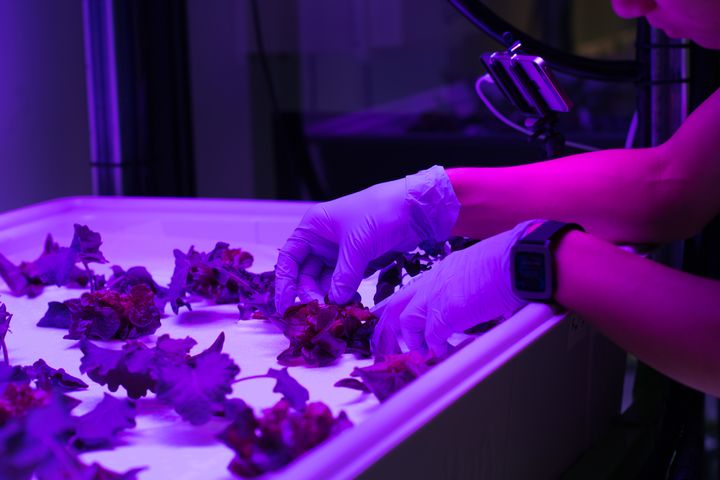
Much of the work will be conducted in Runkle’s Controlled-Environment Lighting Laboratory (CELL), which opened in 2017 and is used to study how plants grow under various environmental conditions, such as various colors of light. The findings will be tested at partner locations.
For more information, visit scri-optimia.org.
— Cameron Rudolph, Michigan State University
The Controlled-Environment Lighting Laboratory, led by Erik Runkle, a professor in the MSU Department of Horticulture, will be used to grow leafy greens for a new U.S. Department of Agriculture-funded project. Photo: Michigan State University