

State of the industry 2012





From 2006 through 2010, the value-added fruit and vegetable categories increased supermarket dollar sales by nearly 10.9 percent and 18 percent respectively. After slight dips from 2008 to 2009, each category posted consistent yearly increases in dollar sales and volume. Trends including steady development of new products, healthy snacking alternatives and convenience each lend to the continued success of value-added produce.
Shopping behaviors clearly reflect the high value consumers place on fresh, time-saving produce options. Despite value-added fruits’ higher price points compared to whole fruit, consumers increased their number of purchase trips by 2.8 percent on average during the 52 weeks ending Sept. 24, 2011, according to the Perishables Group’s FreshFacts Shopper Insights powered by Spire. The category also held steady in household penetration.
Buyers remained loyal to fresh-cut fruit segments like grapes in 2011, which had a 27 percent volume increase and 30 percent dollar increase despite a 2 percent increase in average retail price.
In certain cases, value-added fruits out-sold traditional bulk offerings. Throughout 2011, bulk watermelon held steady in dollar sales and decreased in volume after a 5.0 percent increase in average retail price from the previous year. Value-added watermelon also saw a rise in average retail price; however, unlike bulk watermelon, consumers continued to purchase despite the increase. Average dollar sales for value-added watermelon rose 8 percent, while volume increased 3 percent.
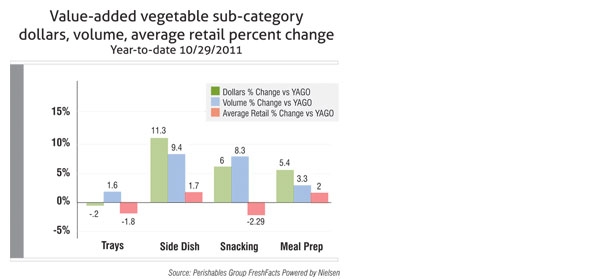
Value-added vegetables also fared well in the past year. The average retail price of value-added vegetables remained unchanged in 2011, which had a positive effect on category dollars and volume. Both volume and dollar sales for value-added vegetables grew by 7.2 percent.
Within the value-added vegetable sub-categories, several segments experienced similar patterns of rising prices having little impact on volume and dollar increases. Rutabaga had a 27 percent increase in average retail price and a 21 percent increase in volume, resulting in 54 percent growth in dollar sales. Other categories within fresh-cut vegetables exhibited similar behavior, including sweet potatoes and Brussels sprouts.
The steady expansion of value-added fruits and vegetables in supermarkets is hardly surprising when examined against consumer trends and the increasing number of value-added items on grocery shelves. The impressions (number of unique items on store shelves) of fresh-cut fruit and vegetables increased by 7.2 percent and 3.6 percent respectively in 2011, as retailers dedicated more space to these valuable products.
Value-added fruit experienced impression growth across the board. At 11 percent, the overwrap sub-category posted the greatest increase in impressions, which corresponded with the category’s largest increase in dollar sales (10.3 percent). With a 7 percent increase in impressions, fresh-cut fruit continued growth as value-added fruit’s largest sub-category. Even the category’s smallest increase in impressions was significant; jars and cups had a 6.5 percent increase in impressions.
Value-added vegetables experienced similar growth in impressions. The side dish sub-category, accounted for a full 52.9 percent of value-added vegetable dollar share, driven by impressions growth of 3.3 percent. Meal prep items had the largest increase in impressions compared to a year ago (6.0 percent), followed by side dish items (3.3 percent), snacking (2.5 percent) and trays (1.4 percent).
The continued success of value-added produce is evident in their expansion on grocery store shelves and prominent place in consumers’ shopping carts. With the stamp of approval from retailers and consumers alike, value-added fruits and vegetables weathered the economic storm, responding to consumer demands for health and convenience, and ultimately flourished in the aftermath.
Unless otherwise noted, sales data is for year-to-date 2011 (through Oct. 29). Sales data was compiled from grocery stores nationwide, representing 61.5 percent of national supermarket ACV share. For more information, call Kelli Beckel at the Perishables Group at 773-929-7013 or email kelli.beckel@perishablesgroup.com.
The Perishables Group (PG) is a Chicago-based fresh food consulting firm offering a full spectrum of products and services geared toward complete market and category understanding. Solutions include research, analytics, marketing communications, category development, promotional best practices and shopper insights. We have more than 10 years of experience refining tools and strategies for maximizing success in the perishables departments. For more information, visit www.perishablesgroup.com.