

Improving refrigeration efficiency can root out hidden cold chain costs
Despite refrigeration accounting for a significant share of facility energy use — often as much as 60% — many plants lack the tools to measure and interpret performance in real time.





In food and beverage facilities, refrigeration systems rarely fail without warning, and energy consumption can inch upward with no clear cause. While these small shifts are easy to dismiss, they signal a deeper issue that can quietly erode efficiency and inflate operating costs.
“The signals are usually there; they’re just easy to rationalize away,” said Stefano Ghidella, global business development manager for refrigeration at electrification and automation technology company ABB. “You might notice the compressor is running longer than it used to or cycling more frequently. Temperatures take slightly longer to recover after a loading event.”
What makes these early warnings so challenging is their subtlety. Without a clear baseline, operators often attribute changes to normal variability such as seasonal demand, weather fluctuations or production spikes rather than underlying inefficiencies.
“In reality, the system is already working harder than it should be to deliver the same result,” Ghidella said. “That extra effort has a cost, both in energy and in equipment wear.”
The visibility gap
Despite refrigeration accounting for a significant share of facility energy use — often as much as 60% — many plants lack the tools to measure and interpret performance in real time.
“A big part of the challenge is that refrigeration has traditionally been a mechanical discipline,” Ghidella said. “If the food is cold and the compressor is running, the system is ‘working.’ That’s a reasonable rule to follow, but it doesn’t tell you whether the system is working efficiently.”
Monthly utility bills provide only a broad snapshot, offering little insight into where energy is being consumed or lost. Without granular data, inefficiencies remain hidden within a single line item.
“You can’t manage what you can’t measure,” he said.
That lack of visibility is compounded by competing priorities on the plant floor, where production throughput and product quality often take precedence over energy optimization.
“Inefficiencies are easy to miss when you aren’t looking for them in the first place,” Ghidella said.
Operational reality
Even well-designed refrigeration systems can drift from optimal performance once they’re in operation. One of the most common issues lies in how systems are sized and utilized over time. Equipment is typically designed to handle peak demand and maximum production on the hottest day of the year, leaving it oversized for everyday conditions.
“That means compressors spend a large chunk of their operational life running at partial load,” Ghidella said. “With traditional fixed-speed systems, that partial load operation is inherently inefficient.”
The result is a persistent gap between design intent and operational reality that becomes embedded into daily operations.
“The plant commissions the system, it works, and everyone moves on,” he said. “The inefficiency becomes the baseline.”
Similar patterns appear in pumps and evaporator fans, which often operate at constant speed despite fluctuating demand.

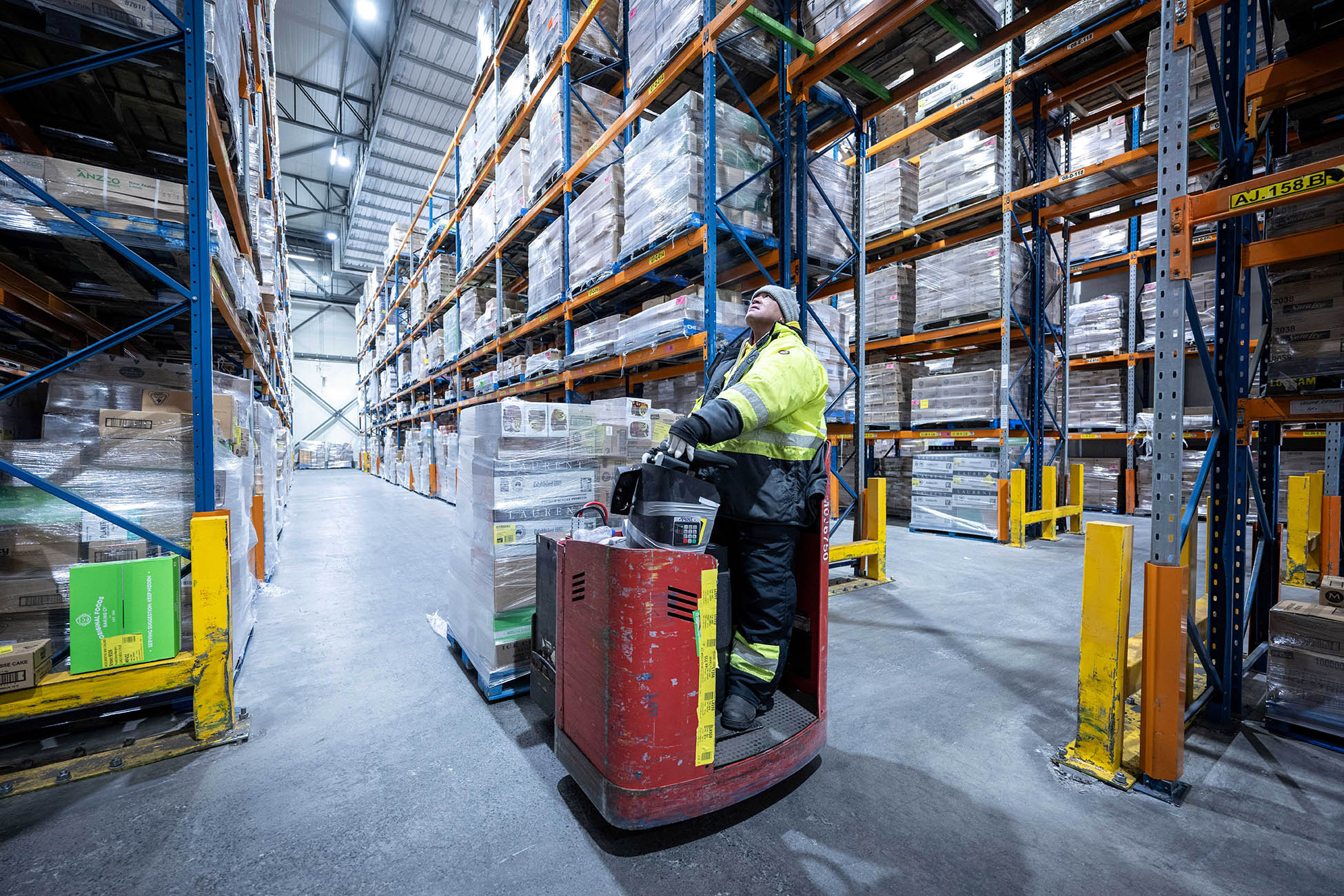
Monitoring day-to-day operational practices, such as handoffs between the warehouse and transportation, can help cold storage operators like Americold limit inefficiencies and keep costs down. Photos courtesy of Americold.
Turning data into action
Facilities are beginning to close that gap by rethinking how refrigeration systems are monitored and managed.
“The facilities that are pulling ahead are the ones that have changed the way they look at refrigeration, from background utility to a managed asset,” said Brith Isaksson, ABB global segment manager for food and beverage.
That shift starts with capturing data on energy use, pressures, temperatures and equipment runtimes and extends to how that information is used.
“Data alone isn’t the answer,” Isaksson said. “What matters is having a clear baseline to compare against, and the tools and training to interpret deviations meaningfully.”
Some facilities are implementing dashboards that automatically highlight anomalies, while others are integrating refrigeration performance into broader operational key performance indicators (KPI).
“The cultural shift is just as important as the technological one,” Isaksson said. “When energy performance becomes something the whole team is accountable for, you start catching problems much earlier.”
A measurable impact
While large-scale system upgrades can deliver significant gains, many efficiency improvements come from relatively simple adjustments.
“Some of the most impactful changes don’t require a full system overhaul,” Isaksson said. “Establishing proper energy sub-metering for refrigeration is a relatively low-cost step that immediately changes the conversation.”
With better visibility, inefficiencies that were once invisible become actionable.
“In many plants, evaporator fans and cooling tower pumps run continuously at full speed regardless of demand,” she said. “That’s a straightforward area where variable speed control can deliver very significant energy reductions.”
Even setpoint adjustments can have a meaningful effect.
“Systems are often running colder than product specifications actually require,” Isaksson said. “Every degree of unnecessary overcooling has a real energy cost.”
Operational discipline in cold storage
For cold storage operators, the challenge extends beyond equipment performance to include day-to-day operational practices.
“One of the biggest opportunities to manage costs is at the handoffs between transportation and the warehouse,” said Brian Dunn, senior vice president of facilities and engineering and head of sustainability for cold chain solution provider Americold. “Long dock dwell times, incorrect trailer setpoints, doors left open or product landing in the wrong temperature zone introduce unnecessary heat load.”
These seemingly minor issues can have a cumulative impact on energy consumption and system strain.
“Practices such as pre-cool checks, door discipline, smart load sequencing and scan-verified product placement make a meaningful impact when they’re embedded into daily operations,” Dunn said.
Americold addresses these challenges through its Americold Operating System, which standardizes energy management practices across its global network.
“By standardizing these practices at scale, we reduce energy use and emissions while protecting product quality and system reliability,” Dunn said.
From reactive to proactive management
The industry is increasingly moving away from reactive maintenance toward a more proactive approach, driven by advances in automation and analytics.
“For a long time, the model was ‘something breaks, fix it,’ ” Isaksson said. “But modern automation and control technology is changing that fundamentally.”
Variable speed drives and advanced control systems now provide continuous feedback, enabling operators to detect deviations early and adjust performance in real time.
“That data can be used to detect developing faults before they become failures,” she said. “You start to get a much richer and more actionable picture of system health.”
At Americold, this shift is reinforced through real-time monitoring and network-wide visibility.
“Our monitoring platforms provide continuous insight into power consumption and refrigeration performance across facilities,” Dunn said. “That allows teams to see what’s happening as it happens.”
Advanced analytics and AI-enabled controls are also playing a growing role.
“We use these tools to flag anomalies sooner and fine-tune system behavior in real time,” Dunn said. “That allows teams to address issues early before they turn into larger cost or reliability concerns.”
Rising energy costs and increasing sustainability expectations are accelerating the focus on refrigeration performance.
“There is a real sense of urgency that wasn’t there five years ago,” Isaksson said. “Energy costs are rising, margins are tighter and expectations around measurable sustainability progress are becoming increasingly concrete.”
As a result, refrigeration is gaining attention at higher levels.
“Energy reduction and carbon reduction are becoming board-level priorities,” she said. “The business case for improving refrigeration performance has never been stronger.”
For large-scale operators like Americold, that means taking a long-term, data-driven approach to investments.
“We assess whether an investment will operate efficiently at scale, adapt to changing volumes and environments, and strengthen system reliability over time,” Dunn said.
Looking ahead, the future of refrigeration management lies in anticipating issues rather than reacting to them.
“I think we’re at a genuine turning point,” Ghidella said. “The industry has been slower than others to digitalize its refrigeration infrastructure, but that’s changing.”
As technology becomes more accessible and energy economics shift, more facilities are adopting tools that enable proactive decision-making.
“What I hope we’ll see is that small deviations get noticed and acted on before they compound,” Ghidella said. “That’s a future that’s achievable for most plants today.”