

Heating and cooling in food processing facilities and product
Temperature control in both facilities and in the food itself are important factors for produce processors. Colmac Coil and Weber Cooling offer insight.





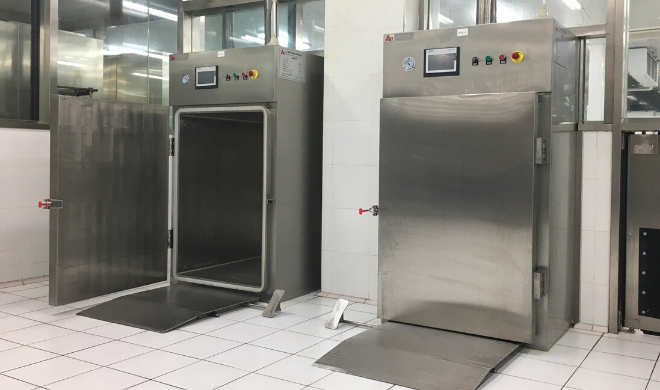
Perishable food items require very specific temperature, humidity and ventilation conditions before processing and after processing, if still remaining the perishable state, (i.e., bagged salads, cut fruit).
That’s just for the environment of the food. In many cases of produce processing, the product itself must be heated and then cooled.
We recently spoke with two companies, one an industrial heating and cooling designer, and the other that deals with cooling cooked food, on the subject.
Professional Engineer Bruce Nelson is the president of Colmac.
What are some of the most common inefficiencies you see?
Nelson: There are many opportunities to save energy and increase operating efficiency with industrial food refrigeration systems. Some opportunities are related to the components themselves, the compressors, condensers, refrigerant feed system and pipework, and evaporators found in the system.- Were the components selected with energy efficiency in mind when the plant was built?
- Have the components been properly maintained over the life of the plant?
- Was the control system properly designed and is it being operated optimally at full and part load?
How can production facilities improve their energy efficiency?

Colmac Coil offers large industrial facility heating and cooling equipment. Photo: Colmac Coil
Nelson: It has been shown that as much as 60% of the heat that is expended during a defrost cycle is lost to the refrigerated space due to convection of heated air and evaporated moisture. This wasted heat can very effectively be captured at the air cooler by installing return air defrost hoods and discharge air socks.
Proper hot gas defrost piping both internal and external to the evaporator is also critically important to the energy efficiency of the defrost cycle. In a word, the fewer and shorter the defrost cycle for a given evaporator the better.
Another new technology that reduces the number of defrosts required is demand defrost sensing and control. Normally evaporator coils are defrosted based on a timed schedule — they go through a defrost cycle whether they need to or not. With the application of demand defrost, the defrost cycle is initiated when the sensor indicates frost has grown to a thickness of (approximately 1 to 1.5 millimeters). Applying these three features together to the design and operation of air coolers:
- Return air hoods and discharge socks.
- Proper piping and reduced defrost times.
- Demand defrost sensing and control, operators of industrial refrigeration systems can reduce the amount of energy expended on defrosting by 80 to 90%.
What are the benefits to vacuum cooling?
van Uden: Usually it takes many hours to cool a product that has been cooked or baked, but vacuum cooling ensures ultra-fast and uniform cooling. Your cooling time will be reduced to minutes, preserving food quality and minimizing bacteria growth, thus maximizing shelf life. All products are cooled uniformly, to the core. Only with vacuum can you really control your temperature.Vacuum cooling will also benefit your cooked, baked and fried food in many other ways. In addition to avoiding bacterial contamination and prolonging shelf life, it can improve the taste, texture and volume in some foods. It also minimizes space requirements and energy needed; 55 to 90% in savings can be achieved.
What are the key points of advice you offer customers on this technology?

Food that has been quickly cooled using vacuum cooling technology. Photo: Weber Cooling
van Uden: We can advise you on which products will cool easily, which products require special adaptation or that cannot be cooled at all. As a rule of thumb, if water vapor can be released through the surface of the food, it will cool. As cooling takes place by evaporation (cooking), some of the water releases from the product. Sauces and soups can be difficult to cool (due to splashing). Sausages and airtight-packed food will not cool.
On the other side, the smaller the individual parts, the easier and fast cooling can take place. Rice, pasta and potatoes, sliced or minced meat and cut vegetables will cool fast and uniformly.
Cooling down from around 175-210°F (80-100°C) to around 85°F (30°C) can be done within 5 to 10 minutes with the right machine).
Cooling down to temperatures below 50°F (10°C) might take up to 20 to 30 minutes. With vacuum you can cool down close to freezing, but the highest cooling efficiency and speed will be achieved at higher temperature levels.
Can companies test this out?
van Uden: Weber Cooling offers the option of testing the products so customers can see how vacuum cooling will impact their process. We have testing centers in Europe and Asia where our customers can perform tests together with our experts. Besides this option, we also offer the possibility of renting a small (demo) vacuum cooler to perform a test at a customer’s location. In either case, when a system is installed customers always receive training on location so that operators learn how to run the system.Top photo — Weber Cooling’s vacuum cooling systems allow for quick cooling after harvest or cooking. Photo: Weber Cooling