

Maintaining precision at scale key to complex process of fruit ripening
Large ripening operations are balancing multiple customer programs, tighter delivery windows and expanding distribution networks, all while maintaining consistency.






Retailers today expect more than ripe fruit. For instance, they expect bananas and plantains to arrive at distribution centers with precise color, predictable shelf life and consistent eating quality, regardless of where the fruit was ripened or when it reaches the shelf.
Meeting those expectations has become increasingly challenging as supply chains have grown more complex and customer specifications more demanding. Large ripening operations are now balancing multiple customer programs, tighter delivery windows and expanding distribution networks, all while maintaining consistency across every ripening room.

“Ripening is an art,” said Anthony Serafino, president and principal of North Bergen, New Jersey-based Exp. Group. “Anyone can turn fruit yellow, but delivering the right color, shelf life and consistency for each customer requires discipline and precision.”
That combination of operational expertise and increasingly sophisticated technology is reshaping how commercial ripening facilities approach their business. Rather than simply moving fruit through ripening rooms, today’s operators are managing customized programs designed around each customer’s distribution model and merchandising strategy.
Scaling with consistency
Growth is often a barometer of success, but for commercial ripeners, it also introduces new operational challenges.
Exp. Group has expanded its ripening operation in four distinct phases since entering the business more than a decade ago, growing from seven ripening rooms to 35 while continuing to add capacity. Throughout that expansion, maintaining consistent performance has remained the company’s top priority.
“As you scale, you really want to replicate your vision and your product across the nation,” Serafino said. “It’s very important to understand that we want the same secret sauce at all of our locations.”
That philosophy extends beyond infrastructure and into supplier relationships. Serafino said one of the biggest challenges growing operations face is finding vendors capable of expanding alongside them without sacrificing service or performance.
“You see a lot of vendors that can only service you at a certain level,” he said. “The beauty is finding partners that can work with a small client and then continue supporting you as you become much larger.”
For operations handling tens of thousands of boxes each week, consistency is built through repeatable processes rather than individual decisions. Every room, every cycle and every facility must deliver comparable results.
Greg Akins, president and CEO of Norfolk, Virginia-based Catalytic Generators, said consistency begins with eliminating unnecessary variability in ethylene application.
“Our systems are designed to provide a steady, controlled and reliable source of ethylene,” he said. “That removes variability from the application side and allows operators to focus on managing the ripening process itself.”
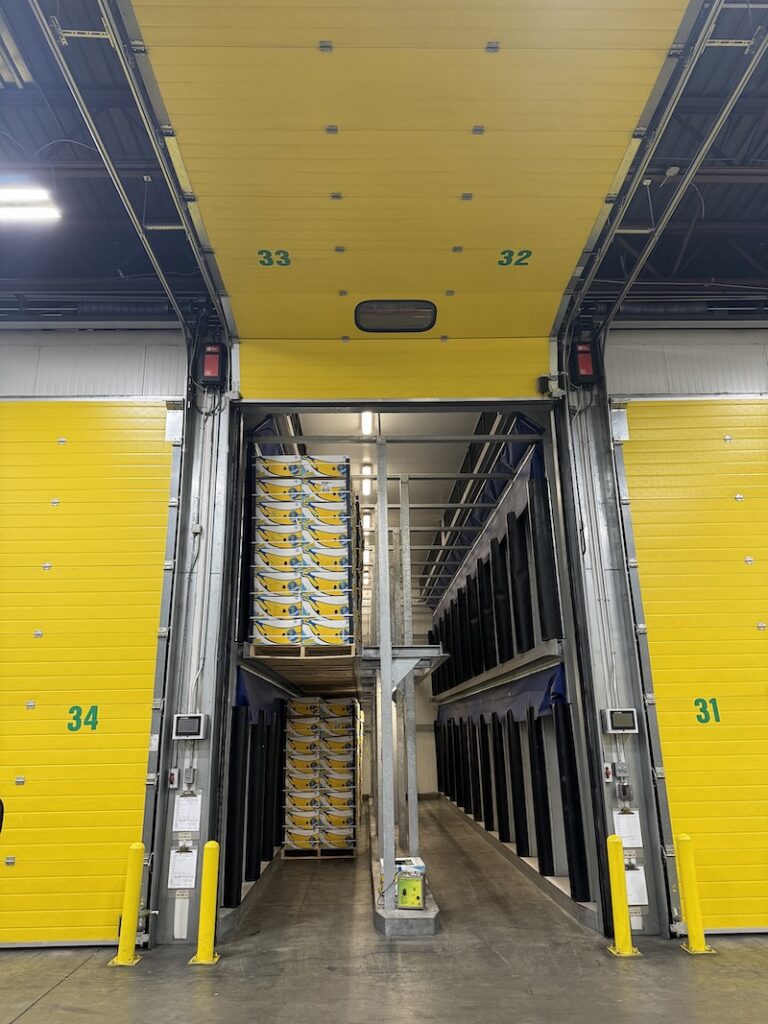
Exp. Group has expanded its ripening operation in four phases since entering the business more than a decade ago, growing from seven ripening rooms to 35. Photo courtesy of Exp. Group.
Customization drives modern ripening
While consistency is essential, commercial ripening is far from a one-size-fits-all operation. Different retailers have different expectations depending on their inventory levels, store formats and replenishment strategies.
For instance, one customer may require greener fruit capable of holding longer in distribution, while another may need higher-color fruit ready for immediate merchandising. Managing those varying specifications requires equal attention to process, equipment and personnel.
“The biggest thing is knowing your client,” Serafino said. “Some customers want fruit at two colors. Others want four colors. Some want it greener, some want it more yellow.”
Unlike many manufacturing processes, fruit ripening offers little opportunity for correction once the process begins.
“Once you really gas the fruit, there’s no going backwards,” Serafino said. “You can only get more ripe — you can’t get less. It’s finding that right sweet spot.”
That places tremendous importance on operator experience. Serafino describes ripening as a combination of knowledgeable employees supported by reliable technology.
“You can have the best drivers, but if you don’t have the car keys, it doesn’t matter,” he said. “The two things work hand in hand.”
Customer expectations have also evolved significantly during the past decade. Akins said retailers are no longer satisfied with fruit reaching a general color stage.
“Customers are asking for very specific outcomes tied to shelf life, distribution models and how quickly the product will move through the supply chain,” he said.
Shorter supply chains, more frequent deliveries and expanding last-mile distribution have reduced the margin for error.
“Retailers and foodservice operators expect consistency across every delivery,” Akins said. “That puts more pressure on ripening operations to deliver predictable results at scale, even when managing multiple customer specifications.”
Removing variability
Ethylene remains the foundation of commercial fruit ripening, but how it is delivered has become increasingly important as operations grow larger and more complex.
One challenge operators face is ensuring a reliable supply. Since ethylene serves numerous
industrial applications beyond produce, availability is vulnerable to broader market conditions and geopolitical disruptions.
“Our systems are designed to operate independently of petrochemical-derived ethylene supply chains,” Akins said. “By enabling on-site ethylene generation, we give ripening operations greater control over supply while reducing exposure to external volatility.”
Equally important is simplifying the application process itself.
“We focus on doing one thing extremely well: ethylene application,” Akins said. “Our approach is built around simplicity, stability and reliability.”
That simplicity translates into less uncertainty during daily operations.
“Teams shouldn’t have to guess whether ethylene is being applied correctly,” Atkins said. “When the system is simple, reliable and predictable, they can focus on optimizing ripening cycles, meeting customer specifications and running their operations efficiently.”
As facilities expand across multiple locations, those benefits become even more valuable. Serafino said technology plays an important role in helping Exp. Group replicate the same quality regardless of geography.
“We want the same product at all our locations nationwide,” he said. “That’s something we’re really building into our growth strategy.”
He compared that consistency to a restaurant chain delivering the same customer experience regardless of location.
“When you have vendors that have the capability to scale with you, it makes achieving that consistency much easier,” Serafino said.

Looking ahead
Technology continues to push commercial ripening toward greater precision. Akins expects future innovations to focus on increasing operator visibility through digital monitoring and real-time system management.
“We’re seeing a continued shift toward precision and consistency,” he said. “Operators want to know exactly what’s happening in the room, when ethylene is applied, how systems are performing and whether everything is running as expected.”
New digital capabilities are beginning to provide remote monitoring, automated alerts and greater operational transparency, allowing operators to identify potential issues earlier while maintaining tighter process control.
At the same time, opportunities for growth continue expanding beyond traditional banana programs. Although bananas and plantains remain Exp. Group’s primary business, Serafino said modern ripening infrastructure offers flexibility to handle additional commodities, including papayas and avocados. He said specialization will become increasingly important as retailers evaluate whether to manage ripening internally or rely on dedicated experts.
“We have a common specification for every client,” Serafino said. “It’s not a one-size-fits-all model. We have a model that works for each individual customer.”
As customer expectations continue rising, the ability to consistently deliver customized ripening programs may become one of the industry’s strongest competitive advantages.
“It’s about giving ripeners more visibility, more control and ultimately more confidence that the process is working as it should,” Akins said.